Friday, June 16, 2006
World Cup 2006: This is NOT just a game!
The embarrassing defeat handed to the U.S.A. squad by the top notch Czech Republic team last Monday was painful and I have had to take the obligatory America-bashing and (un)informed commentary about the lack of professional skills and interest in soccer in the United States all week from friends and colleagues and even strangers on the street. It’s gotten so bad that just the other day a stray (German) dog tried to pee on my leg just to show his disdain and disapproval for the U.S. team’s poor performance. He missed. Therefore I’ve added some additional links below to sites that focus on the U.S. sports news coverage of the World Cup 2006. This is for my readers who are interested in knowing the facts vs. the opinion of the average dumb—s expert on U.S. soccer I have to put up with here in Good Old Europe on a regular basis.
By the way, the American women soccer fans outnumbered the guys by at least 3-1 in the pub at the opener against the Czechs. Of course “the Boyz” put on a big comedy show to keep the girls laughing and upbeat at what would have otherwise been an evening of pure misery. The handful of Czech and German fans in attendance loved the show too, albeit they probably didn’t understand how we were losing the game and still having great fun. Crazy Americans.
There has been some outstanding coverage of the World Cup 2006 in the blogosphere and I am surprised how extensive media sites such as Sports Illustrated and ESPN have adopted blogs for their readers and soccer fans from around the globe. Speaking of globe, Global Voices published a post just yesterday about the cool blend of Hip-Hop and World Cup Soccer over at the Soul on Ice blog. BBC News online today highlights African bloggers writing about the competition in the article “Blogging Africa’s World Cup”. Just in time for tonights hot matches between Holland vs. Ivory Coast and Mexico vs. Angola. It looks as if Argentina has sent Serbia-Montenegro packing at the time of this writing with a 6-0 shellacking. Wow! Gotta go. My beer is getting warm.
P.S. Regarding the title of this post, I stole it from an ESPN advertisement over at the Sports Illustrated website. I thought it was pretty cool so here is the text of that ad as best as I can remember:
This is NOT just a game.
This is about honor, glory, passion.
THIS is the World Cup!
One game changes everything.
It close the shops.
Closes the schools.
Closes a city.
Fuels a nation.
Breaks the borders.
Builds a hero.
Stops a war.
Crushes a dream.
Answers a prayer.
Amen, Brother. (I added this line)
Sports Illustrated FIFA World Cup 2006 special
SI World Cup official blog
SI Writers – Grant Wahl, Richard Deitsch,
SI Blog post: Can the U.S. defeat Italy?
ESPN SoccerNet – FIFA World Cup 2006
ESPN Podcast Center – World Cup 2006 podcasts
Technorati tags: World Cup 2006 world cup soccer Football Global Voices
Friday, June 09, 2006
World Cup 2006: Die Welt zu Gast bei Freunden
As you can imagine the Stimmung (mood) is one of very high excitement all over the country and it is great to see the German people castoff their typical terrible habit of complaining about every damn thing under the sun and give some real meaning to the phrase Willkommen in Deutschland (Welcome to Germany). I must say that the German people have outdone themselves in working so hard to make this World Cup event a success and enjoyable for everyone, so the world will be looking forward to the next four weeks of Football Fever with excellent and fair play on the field and off.
The hometown team (U.S.A. Men’s National Team) faces the formidable Czech Republic on Monday night (6/12/06) and then they play the Italian team (6/17/06) followed by a match with Ghana (6/22/06). It’s an uphill battle for my favorite team but I figure if Bruce Arena can lead the U.S. Boyz to victory in the very tough Group E then it will be a breeze all the way to the quarterfinals and perhaps on to the (God forbid) championship match. The U.S. Men’s National Team is often the butt of jokes and teasing over here in Europe (and amongst my African buddies) but I remain a diehard fan and will fight for them in the pub and on the streets (Bring 'em on!) while they take care of business on the football pitch. The U.S. Team by the way is rated Number 5 out of the 32 teams qualified for the World Cup this year. As the great Brazilian champion footballer Pelé was saying the other night, “Anything is possible at the World Cup!” More about this great sporting event later, I think that my lovely little Geman Pils may be getting a bit too warm down at the Kneipe (pub).
Good Luck at the World Cup 2006 to all of my readers who are avid football fans. May the best team win and hoping that you have a great time at the biggest party on the planet whether you are here in Germany or at home in the World with family and friends.
Der Spiegel World Cup 2006 Special (English)
Der Spiegel’s World Cup 2006 Germany Survival Bible (English)
German government official World Cup 2006 website (multilingual)
U.S. Soccer official website, blog, and daily podcasts (Americanisch)
BBC News World Cup 2006 Special (The Queen's English)
Technorati tags: World Cup 2006 world cup soccer Football Global Voices
Friday, June 02, 2006
CNN Exclusive: DR Congo President Joseph Kabila interviewed about mass rapes in the Kivus
Congo president on military rapes: ‘Unforgivable’ – CNN May 31, 2006
During the interview Jeff (we’re on a first name basis) visits President Kabila at his compound in Lubumbasha and shows him the video footage from the May 26th CNN broadcast. Sitting at an outdoor garden table with Jeff’s Apple notebook computer in front of him President Kabila displays a look of shock and disgust as he views the testimony of a 15 year old boy who was gang-raped by soldiers that had first killed both of his parents, then raped his two young sisters to death, before starting in on him for hours or days. The boy says that he was sodomized by at least 20 uniformed soldiers who had told him when they seized him and tore off his clothing that his “sisters had not satisfied them”. This youngster was only 12 years old at the time of his rape. The surgery and medical care needed to restore the young man back to health took more than 6 months. He is presently living in the temporary custody of a local minister and the women of his community. This unfortunate young man is now psychologically scarred for life because of this senseless brutality.
Koinange asked the young president about how he feels after viewing this report and President Joseph Kabila replied after a long pause, “Shocked!” President Kabila was then asked what he would do if such acts were carried out against his own twin sister, mother, or six-year old daughter and he replied, “You already know the answer to that [question].” Kabila went on to say that over 300 soldiers of the Congolese Armed Forces and rebel militias had already been prosecuted for such crimes in the DRC, in stark contrast to various reports by human rights groups i.e. Amnesty International (Congo report 2005, AI DRC report library) and separate investigations by the United Nations and MONUC.
President Kabila, who served under his late father Laurent Désiré Kabila as a military commander in the two Congo Civil Wars and later went for advanced military studies to the People’s Republic of China’s National Defense University (there’s that China-Africa Win-Win policy again) also stated in the CNN interview:
"It's shameful that soldiers anywhere are allowed to do such things," he said. "That's why I want to be president. I want to change this. I want to make security one of my first priorities so that these and other acts come to an end once and for all."
I can only say, “So do we the people of the world, Mr. President. We demand that you do everything possible to bring an end to this indescribable violence against innocent women and children in your country. Just let us know how we can best help you. Keep on talking with us.”
Below are links to additional information about the crisis in the eastern DR Congo provinces of North Kivu and South Kivu. Pay particular attention to CNN correspondent Anderson Cooper’s blog report on the victims of mass rape being treated at Panzi Hospital in Bukavu and please note the special work being done by the Goma Film Project where our friend and fellow blogger Louis Ableman has devoted so much time and energy to help the victims of mass rape in Goma.
CNN’s Anderson Cooper 360° blog
Gang raped and mutilated but still praising God – May 25, 2006
CNN International
Rape, brutality ignored to aid Congo peace – CNN May 26, 2006
Congo president on military rapes: ‘Unforgivable’ – CNN May 31, 2006
CNN Inside Africa program with host Femi Oke
Wikipedia, the free encyclopedia
Democratic Republic of Congo
Kinshasa
Relief Web Maps of the DR Congo: (see maps)
Contact DR Congo President Joseph Kabila at his official website and let him know that you read this post and saw him on the web and on CNN and that we are all hopping mad about what’s going down in the eastern DR Congo. And while you’re at it, ask him to get some English language pages up on his website. After all, his English skills were very good today on CNN. Indeed.
Technorati Tags:Africa Congo DR Congo human rights News Global Voices
Thursday, June 01, 2006
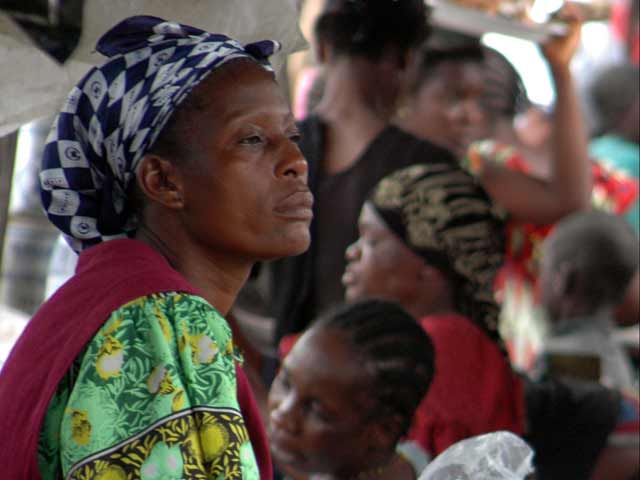
Kinshasa, DRC: Women at marketplace in December
TIME: Congo - The Hidden Toll of the World's Deadliest War

TIME Magazine Cover - June 05, 2006 issue
Photo copyright: TIME Inc.
See the related post On the Mississippi with Visitors from Kinshasa for more information.
Wednesday, May 31, 2006
Germany: On the Mississippi with visitors from Kinshasa, DR Congo
While the world’s attention is focusing on Germany for the start of the Beautiful Game Championship (World Cup 2006) only 8 days away, my attention is focused on another beauty here in Germany today. This beauty is from the Democratic Republic of Congo and her name is Mama Emily. This post to Jewels in the Jungle is dedicated to her and all the mothers and grandmothers of her country who have survived years of turmoil and neglect to see a better day.
The TIME magazine cover story for the June 5, 2006 issue is a feature about the Democratic Republic of Congo titled “The Deadliest War in the World” written by Simon Robinson and Vivian Walt. The report is about the simmering conflicts and continuing atrocities and suffering of people in the eastern provinces of this vast African country that is larger than Western Europe. CNN published a summary of the TIME article on May 28th along with related features on the DRC. There has been some light coverage of the story in the blogosphere and on the Web. The TIME Magazine cover story attempts to illustrate the many dangers and complicated issues facing the people of the DR Congo before their scheduled July 30th national elections, the 1st democratic elections to be held in this country in over 40 years.
On May 24th CNN’s Jeff Koinange reported on the 1000’s of brutal rape victims being treated at the Panzi Hospital in Bukavu, a major city in the war torn eastern DRC province of South Kivu. The CNN article and video report is very disturbing as it draws attention to the plight of desperate women and children suffering at the hands of the most savage and senseless brutality against human beings imaginable. Louis Ableman of the Goma Film Project and his team have just completed the feature documentary LUMO, a film about women and girls in Goma who are the victims of thousands of incidents of sexual violence and murder carried out by various militia groups and soldiers operating in the eastern DRC province of North Kivu. Martin Bell, a former BBC News correspondent and presently UNICEF Ambassador for Humanitarian Affairs, did a feature report back in April 2006 for BBC Two Newsnight titled “No Peace for the DR Congo”.But today I want to focus on the positive side of the DRC and move away from all of the clichés i.e. the Heart of Darkness. This is one of those all too rare stories you can read online about people from the DR Congo that has a happy ending.
Three or four years ago I had the privilege to meet and befriend a woman from Kinshasa, DRC (Democratic Republic of Congo) who lives in my neighborhood. Her name is Dédé (pronounced Day-Day) and she has been living in Germany for about 20 years. She is the mother of two lovely grownup daughters and is also the grandmother of my little friend Vanessa who has just begun school this year. Three generations of Congolese and Congolese-Europeans under one roof, all female, is a special experience all by itself. Dédé has been a treasured friend and an incredible reservoir of knowledge about life and customs in central Africa.
Some months before I met Dédé I had been researching information and news online about the DRC, so I was jubilant to have someone from the country to speak with about what’s going on down there, about the history of the country and the customs of various people who live there, about life under the longtime ruler of the country Mobuto Sese Seko, and of course about the Congo civil wars (I and II) that have contributed to the deaths of over 4 million Congolese to date.
Until the time we first met Dédé had only one friend from the U.S.A. and I had never had a friend from the DR Congo. We are able to converse and argue about everything under the sun: global and regional politics, the War in Iraq, religion, history and culture in the Americas and in sub-Saharan Africa, our personal life stories and stories about our families, you name it. Dédé believes that Americans (N.A. & S.A.) are crazy and a very curious people. I have been able to convince her that some people back in the U.S.A. know a little something about Africa and the DR Congo. Of course she realizes that people from around the world care deeply about what is happening in her country even as we remain confused, angry, and frustrated about what we can personally do to help.
My friend grew up in Kinshasa under the regime of the late President Mobutu. Her father worked for many years as a civil servant in the DRC since the 1960’s, so the family did not live under the extreme poverty and deprivation we so often see today as the plight of the majority of people living in Kinshasa and all across the vast country. Dédé’s mother and father hail from Province du Bas-Congo (see maps) in the southwest corner of the country where the mighty Congo River empties into the Atlantic Ocean. All six children in the family received a good education in Kinshasa right through secondary school and some were able to continue their studies in Europe. Dédé has told me some very interesting and many times funny stories about life under Mobutu in and around Kinshasa, and I’ve been told some very sad and harrowing tales about the Congo’s descent into war and chaos in 1996 as Laurent Désiré Kabila with the backing of Rwanda, Uganda, and Burundi mounted a full-scale rebellion against Mobutu Sese Seko.
By May 1997 Laurent Kabila had seized the capital city of Kinshasa with various rebel militia groups and rebel Zairean Armed Forces members united under the ADFL. This march of death and destruction swept across the length and breadth of the nation, having begun in the volatile eastern province of South Kivu thousands of kilometers away from the capital. Dédé understands firsthand what it is like to be at the business end of an automatic weapon aimed at your head while marauding militias and armies are sacking a city and threatening to rape and kill you and your family. Fortunately she and her family members escaped such terror unharmed while she was visiting Kinshasa before the start of the 2nd Congo War.
What makes the TIME magazine article so relevant for me today is that after anxiously waiting for almost 8 years Dédé has family visitors from Kinshasa. Actually WE have visitors because I have been waiting to meet her family from Kinshasa too. Mama Emily (Dédé’s mother) and Jacqueline (her younger sister) are here visiting in Germany for the first time ever. I believe that I am as excited about this special visit from Kinshasa than anyone. For me it is a blessing just to be able to meet and talk with them… about (almost) everything.
Mama Emily is absolutely striking in her appearance, a grand older African woman small of stature with a face that Michelangelo couldn’t do justice to either in stone or on canvas. She has beautiful small eyes set within a petit almond-shaped face. Her dark coffee brown skin is as smooth as silk and practically wrinkle-free despite her advanced years. When I first met her last week for an “afternoon tea”, I couldn’t help but to feel humbled in her quiet presence. When I look into the face of Mama Emily I see the strong, beautiful, proud faces of my own dear grandmother’s (now deceased) back home in the U.S.A.
We had about 5 hours together to talk and get to know one another and I addressed Mama Emily as “Mama” after a short time. I communicated with her via her daughter in English and German, limited French, and my practically non-existent Lingala language skills. I think it was my great effort to speak Lingala with Mama Emily that really won her over at the beginning. A special thanks to my friend Ali (The Malau) at The Salon blog and the Lingala language team over at Wikipedia encyclopedia for providing information about the language online.
In those first hours together it would have been very easy to ask Jacqueline or even Mama Emily about all of the bad news that we hear and read re: the DRC, but that is not what I wanted to do. I spoke briefly with the two daughters about the upcoming elections and the Congo’s history over the past 40 to 50 years while Mama Emily listened on quietly, adding a brief comment here and there. What really captured her attention during that evening is when I began to discuss the history of the New World (the Americas) and how Africa’s and particularly the Congo’s history is so strongly linked to that of our own. You see Mama Emily had seen the renowned TV series “Roots” years ago and the film “The Amistad” more recently and Dédé told me that Mama was very sad to see the suffering of the millions of slaves who were shipped off to the Americas in Roots but was very happy to see that some had been safely returned to Africa (Amistad Case). Therefore, I had to get a few important facts straightened out for Mama Emily as things have changed considerably since those bad old days. Haven’t they?
Another highlight of the evening was when I had the opportunity to guide Mama Emily and Jacqueline through the history of my own people and family in the United States of America, proudly showing books I had brought along containing descriptions and beautiful photos of my hometown Saint Louis, Missouri, a city along a great river just like their own home city of Kinshasa on the Congo River. I explained that the first African-American members of my family had reached the banks of the Mississippi River near Saint Louis by the year 1790 shortly after the end of the American Revolutionary War, having traveled for hundreds of miles on foot and horseback (or mule) from their former home back East. That when they arrived on the great American Midwest frontier they had traveled as free men and women, no longer living in bondage under slavery in post-Colonial America.
NOTE: So readers can get a better idea about what these territories were like back then, follow these links to the PBS special Lewis & Clark Expedition of 1804 and the Wikipedia encyclopedia article Lewis & Clark Expedition of 1804-1806. Ironically, a key member of this historical expedition to explore the lands of the Louisiana Purchase beyond the confluence of the Mississippi and Missouri rivers was an African-American slave named York. At the end of the expedition in 1806 York asked his “master”, William Clark, for his freedom but was refused on the grounds of ‘financial hardship’. Ain’t that a b----! Learn more about this historical American journey at the PBS Living History site about the expedition.
As you can imagine, Mama Emily and her two daughters really loved hearing these stories and examining the pictorial history books about my hometown and country. Black Africans trekking through the wilderness of the New World to start a new life in freedom among native tribespeople, virgin forests and fields full of wildlife and game, a few hundred European settlers, trappers, frontiersmen, and of course eagles soaring high above the limestone bluffs and lush green deltas of the Missouri and Mississippi rivers. I put in an award-winning performance that evening because having the opportunity to tell these tales to our distinguished visitors from the Democratic Republic of Congo was a real joy for me. I think that these stories I told and pictorial histories I shared helped to transport Mama Emily and Jacqueline thousands of miles further than they had already traveled on the flight from Kinshasa to Germany___ and back hundreds of years to a time when many of their own people had survived a difficult but yet incredible journey into a brave New World.
At the end of the evening before I left for home, Mama Emily took my hands into her own to thank me for the time together, to send blessings to my people back in America and my family, and to remind me about something that she had said earlier that evening___ that the people of the Congo still have hope. I trust and believe in what she says with all of my heart.
Melesí Mama Emily & Jacqueline. Wilkommen in Deutschland. Likamboté. I hope to be able to welcome you to America and Saint Louis, MO. one day soon so that we may have coffee and tea by the river near the great arch. Tokomónono Mama. Tokómonono.
A Happy End to a wonderful evening. To be continued…
Technorati Tags:Africa Congo DR Congo Elections Democracy America History Germany Global Voices
Friday, May 12, 2006
Africa Open for Business documentary airing on BBC World TV series in May
BBC World TV will be airing a series about the documentary film Africa Open for Business starting on May 20th. The film by journalist and filmmaker Carol Pineau was funded by The World Bank and featured at the 2005 Cannes Film Festival, the World Economic Forum, the AGOA Summit, and the G8 Summit 2005 at Gleneagles, Scotland. For anyone who has never seen this important documentary about successful entrepreneurship in sub-Saharan Africa, BBC World will offer a 3-part series with airtimes starting Saturday May 20th at 0930 GMT and 1630 GMT. The program is scheduled to repeat on Sunday May 21st at 0130, 1330 and 2030 GMT.
Below is an excerpt from the promo for “Africa Open for Business” on the BBC World Business Frontiers special programmes airing throughout May 2006:
"In a new three-part series, Africa: Open for Business, offers a glimpse of flourishing entrepreneurship in a continent where war, famine, natural and man-made disaster is rife. The series features a variety of small and larger businesses in 10 African countries, offering an insight into the continent that is not seen very often by the rest of the world.
They are inspiring stories of human force of will, demonstrating that Africa is viable, has capacity and can be competitive in the global economy. The series features a wide range of companies, from a tiny café in Kampala to a major flower exporter in Kenya. Some of the companies operate in African countries with good governance; others operate with no government at all.
The series speaks directly to the individuals behind the initiatives, looking at the successes, the struggles, the challenges and the solutions involved in running a business in Africa. Companies featured include HFC Bank Ghana Ltd, the largest provider of housing finance in Ghana today; Homegrown, a Kenyan company who export vegetables and flowers to all the UK supermarkets; and Pictoon in Senegal, Africa’s only animation design studio that produces TV series and feature films."
More information about the film and the director/producer Carol Pineau can be found online at the links listed below:
Africa Open for Business official website
Africa Open for Business - World Bank news (Mar 18, 2005)
Africa Open for Business – NPR News & Notes (May 20, 2005)
Interview with Carol Pineau – Washington File (Jul 14, 2005)
Interview with Carol Pineau – BBC World Talking Movies (Jul 26, 2005)
Interview with Carol Pineau – allAfrica.com news (Sep 09, 2005)
The Africa You Never See by Carol Pineau - Washington Post (Apr 17, 2005)
Drawing a whole new image of Africa – TIME Europe (Aug 14, 2004)
A TIME Magazine feature on the Senegalese animation firm PICTOON
Timbuktu Chronicles blog by Emeka Okafor – a view of Africa and Africans with a focus on entrepreneurship, innovation, technology, practical remedies and other self-sustaining remedies. If you want to learn about 100’s of great SME business opportunities in Africa, Timbuktu Chronicles should be your first stop.
Technorati Tags: Africa Economic Development Business economics Global Trade Global Voices
Wednesday, May 03, 2006
U.S.-China Relations: An Apology of Sorts
I’ve been reflecting about how I have presented some of my views online about the People’s Republic of China and I am concerned that what I have written may appear to be xenophobic and racist toward the Chinese people. Nothing could be further from the truth and I would never want to encourage people to behave with fear and prejudice toward one another based on ethnicity or anything else.
Chippla, a Nigerian engineer (& outstanding blogger) based in The Netherlands, recently wrote about the growing relationship between Angola and China where we both had the opportunity to express our concerns and ideas in a way that I felt was honest and open. I wrote in the comments section of his post words that I wish to share here with readers of my blog. Although to date I do not have many visitors who read Jewels in the Jungle from inside the People’s Republic of China (my blog is proudly forbidden by the Great Firewall of China) I do hope that some have found ways to outfox the Chinese Internet Police and may be reading this post. If you are on the wrong side of the Great Wall, read fast and remember the Tank Man of ‘89 (PBS). For those of you who would like to know more about Beijing’s censorship of the Internet please read the BusinessWeek article on the Great Firewall of China and also check Global Voices many posts on China and Rebecca MacKinnon’s Rconversation blog. Of course many blog authors and other support the global campaigns to release the Prisoners of the Great Wall.
Here are excerpts from my comments at Chippla’s blog on April 10th:
“I realize that I must appear very Sino-phobic and alarmist in my comments about Chinese investment activities in Africa and elsewhere these days.”
“This aggressiveness is not meant to include the millions and millions of people in [the PRC] China who remain helpless to affect any type of real change in their government. My comments are primarily focused on the small cadre of business and political elites that control practically all facets of Chinese life today.”
“Fact is I DO NOT TRUST anything that the Communist regime in Beijing does both domestically and internationally.”
“Perhaps that is the unfortunate thing for me, that I will never have trust in that country’s foreign policies until I see a radical change in the way mainland China is governed and in the behavior of certain Chinese businesses working in at-risk developing countries.”
“Of course I shall be long dead before that China ever rises.”
Chippla has updated his series on China in Africa with the April 27th post titled “From China Town to Oil Deals” where he writes:
“With regard to China’s recent encroachment on the African continent, I have declared myself a Sino-skeptic a number of times on this weblog, i.e., someone who prefers to be cautious about such a relationship rather than opening his/her arms to warmly embrace the fast-changing giant. China’s presence on the African continent can no longer be taken for granted. And while some European and American media attempt to make sense of it, objective reporting is very difficult to come by.”
Chippla goes on to write:
“The official line from China with regard to how it is portrayed by Western media, when dealing with Africa, is one of disgust. For instance, preceding President Hu Jintao’s visit to Morocco, Nigeria and Kenya, there was significant coverage both in the Western media, and the English-speaking blogosphere about China’s increasing role in Africa. What astonishes one, with regard to the blogosphere coverage, is the diversity of the people who write about these things. They seem to be scattered all across the globe!”
Chippla then highlights a recent “news article” from the PRC government’s media mouthpiece The People’s Daily (English version). Here are some excerpts from that April 26th Chinese newspaper article:
“Western media hypes up China’s ‘economic colonialism’ in Africa, cooking up stories about China’s oil-and-nonferrous metal motivated investment increase in Africa and playing up the ‘threat’ on local business and labor economy by China’s imports of raw materials and exports of manufacturing products.”
“None of those assertions which sound mindful of the interest of the African people are based on facts or go with the tides. Behind them is the intention of sowing discord between China and Africa. As it is known to all, western powers, not China, colonized Africa and looted resources there in the history. There is no historical feuds or interest conflicts between China and African countries. The traditional friendship between China and Africa has a long history and is well-established.”
Normally I would lash out with a snide remark or two about the People’s Daily description of western media news coverage of President Hu’s “historic trip” but out of respect for some dear Chinese friends and colleagues who have had a great influence on my life, I will remain silent for now, and press on.
No American (U.S.) citizen can comfortably give advice to an African citizen or government official about how to handle trade relationships with China. All you have to do is read some of the reports and news articles about U.S.-China relations today to realize that America itself doesn’t really know how to proceed with this bilateral relationship. Lot’s of big problems between the governments of these two countries and between the people of these two countries as well.
Tom Plate, a professor at UCLA (University of California – Los Angeles) and founder of the UCLA AsiaMedia news daily, thinks that Americans don’t really care or understand much about China. Professor Plate wrote in his April 13th article “China’s boss man comes to America”:
"The average American knows less about China than the average Chinese citizen knows about America. This is sad but true. The reason is basically threefold. For one thing, the U.S. news media in general does a poor job of informing the American public about the world in general, about Asia as a region and about China in particular. The second reason is that China is not open enough for the Western media in general to really understand the place, and China usually does a poor job telling its own side of the story. The third reason is that (America's university-age generation perhaps withstanding) the American people are mainly provincial-looking and entertainment-addicted and are far more interested in knowing about the latest with Brittany Spears than with Madam Wu Yi, the brilliant vice-premier of China who was in Washington earlier this month to smooth boss Hu's way.
The average Congressman knows little about China, has never been there, and faces a re-election in November. He/she will do almost anything for votes. An easy target is China's $200-billion-plus trade advantage over the U.S. Of course, if Americans would buy less, use their credit cards less, and spend less time at predominantly Chinese-import emporia like Toys' R Us, that imbalance would reduce quickly. But economic subtleties are not major players in U.S. election campaigns.
The U.S. Pentagon has been complaining about China's military buildup, especially of its submarine fleet. Worrying about and preparing to combat the strength of potential foes is the Defense Department's basic job, of course. So let's be realistic, not conspiratorial. Even so, the Pentagon ought to also point out that China's spends much less money on its military than does the U.S. China does not have bases in the Americas as we do in Asia, and has not invaded any countries recently, as we did Iraq. Are we naïve to want a somewhat more balanced picture from the Pentagon?"
Professor Plate makes some very good points here, but I am not so sure that all of what he is writing can be taken as a matter of fact. Maybe a key point here is the use of the word “average” in describing what U.S. citizens and politicians know about the People’s Republic of China and vice-versa.
My own personal experiences with people of Chinese ancestry in my home country (the U.S.A.) and abroad has been overwhelmingly positive. I have a great deal of respect for my Chinese friends, acquaintances, and colleagues as their lives have certainly touched and shaped my own. I remember many of my Chinese American and Chinese national friends and classmates, neighbors and work colleagues as being exceptionally bright, hardworking, friendly, and an innovative people who were often eager to help with problems of every kind as well as share in the fun and traditions of everyday American life. They worked hard to become accepted as equals in the U.S. against great odds and blatant racism from several other “American” ethnic groups and individuals. The Chinese American people’s struggle for full acceptance and equality in America continues right up to this very day in some places, unfortunately.
The Chinese have been and will always be an invaluable asset to the very fabric of American culture and life, helping to build our great nation from their arrival on the Pacific and Atlantic coasts in large numbers in the early 1800’s. They have toiled right beside us in slavery times and in freedom, fought and died for the United States of America in foreign wars right alongside other Americans, and they have suffered indignities that few other ethnic groups have had to bear i.e. the discrimination against Chinese immigrants from 1882 to 1943 that refused naturalized citizenship to legal Chinese residents in a country where their ancestors had lived and died for generations (ref: The Chinese Exclusion Act). Here is an full excerpt from one of the documents that can be found at the excellent University of Houston Digital History website:
Digital History – Asian American Voices – Racism and the Law
Year: 1854
Annotation:
The California Supreme Court rules that a Chinese witness could not testify against a white man accused of murder. After George Hall was convicted of the murder of Ling Sing, based on the testimony of three Chinese witnesses, Hall’s lawyer argued that a California statute barring testimony by African Americans, mulattoes, and Indians applied to all non-whites. The court concurred.
Text:
The appellant, a free white citizen of this State, was convicted of murder upon the testimony of Chinese witnesses.
The point involved in this case is the admissibility of such evidence.
The 394th section of the Act Concerning Civil Cases provides that no Indian or Negro shall be allowed to testify as a witness in any action or proceeding in which a white person is a party.
The 14th section of the Act of April 16th, 1850, regulating Criminal Proceedings, provides that "No black or mulatto person, or Indian, shall be allowed to give evidence in favor of, or against a white man."
The true point at which we are anxious to arrive is, the legal signification of the words, "black, mulatto, Indian, and white person, " and whether the Legislature adopted them as generic terms, or intended to limit their application to specific types of the human species. . . .
The Act of Congress, in defining that description of aliens may become naturalized citizens, provides that every "free white citizen," etc. . .
If the term "white," as used in the Constitution, was not understood in its generic sense as including the Caucasian race, and necessarily excluding all others, where was the necessary of providing for the admission of Indians to the privilege of voting, by special legislation?
We are of the opinion that the words "white," "Negro," "mulatto," "Indian," and "black person," wherever they occur in our Constitution and laws, must be taken in their generic sense, and that, even admitting the Indian of this continent is not of the Mongolian type, that the words "black person," in the 14th section, must be taken as contradistinguished from white, and necessary excludes all races other than the Caucasian.
We have carefully considered all the consequences resulting from a different rule of construction, and are satisfied that even in a doubtful case, we would be impelled to this decision on ground of public policy.
The same rule which would admit them to testify, would admit them to all the equal rights of citizenship, and we might soon see them at the polls, in the jury box, upon the bench, and in our legislative halls.
This is not a speculation which exists in the excited and overheated imagination of the patriot and statesman, but it is an actual and present danger.
The anomalous spectacle of a distinct people, living in our community, recognizing no laws of this State, except through necessity, bringing with them their prejudices and national feuds, in which they indulge in open violation of law; whose medacity is proverbial; a race of people whom nature has marked as inferior, and who are incapable of progress or intellectual development beyond a certain point, as their history has shown; differing in language, opinions, color, and physical conformation; between whom and ourselves nature has placed an impassable difference, is now presented, and for them is claims, not only the right to swear away the life of a citizen, but the further privilege of participating with us in administering the affairs of our Government.
These facts were before the Legislature that framed this Act, and have been known as matters of public history to every subsequent Legislature.
There can be no doubt as to the intention of Legislature, and that if it had ever been anticipated that this class of people were not embraced in the prohibition, then such specific words would have been employed as would have put the matter beyond any possible controversy.
For these reasons, we are of opinion that the testimony was inadmissible.
The judgment is reversed and the cause remanded.
End of text… DAMN!! That’s Hard. No Justice.
Our entire nation owes a great debt to the Chinese and other Asian peoples who emigrated to the United States of America, for God knows that they did NOT have an easy time and faced unbelievable abuse and xenophobia in the U.S. from all kinds of ethnic groups and people of other races, political leaders and exploitive businessmen___ including lots of exploitation and severe abuse from criminals amongst their very own people.
More can be learned about Chinese American history in the United States at the resources provided below. I place it here up front ‘cause I want you to read and bookmark this valuable information before I continue with my posts about China, the Chinese, and The People’s Republic of China.
Digital History – Asian-American Voices
Note: Digital History is an interactive mega textbook project on American History sponsored by the University of Houston, Chicago Historical Society, The National Park Service, The Gilder Lehrman Institute of American History, and others.
PBS and The Center for Educational Telecommunications
Ancestors in the Americas produced by Loni Ding
Becoming American: The Chinese Experience
Angel Island Immigration Station Foundation
History of Angel Island Immigration Station
AIIS Resource page (a goldmine of documents, videos, the works)
Chinese Historical Society of America and the CHSA blog
Chinese American Museum of Los Angeles (California)
MIT (Massachusetts Institute of Technology)
Chronology of Asian American History
Stanford University
Text of the 1882 Chinese Exclusion Act
Wikipedia
Asian-American Immigration History
To be continued…
Next post on China: The Eagle vs. The Dragon - Round 3
Technorati Tags: U.S.A. foreign policy China East Asia Africa American History Chinese History Global Voices
Thursday, April 13, 2006
Liberia: Charles Taylor - Boogeyman Behind Bars Part I
Like many of my fellow bloggers who write primarily about Africa I have been carefully following unfolding events surrounding Charles Taylor’s attempted flight from justice, capture and arrest, and finally his delivery to the UN Special Court for Sierra Leone. One of Africa’s most feared and ruthless leaders is behind bars and any decent human being should be relieved that he will finally be forced to face the charges for crimes he committed against millions of West Africans. Charles Taylor, the Boogeyman, is behind bars in Freetown, Sierra Leone.
In a way it is a pity that Taylor has dominated Africa news headlines in the international press and media for several weeks, drawing attention away from the very successful visit by Liberian President Ellen Johnson-Sirleaf to the United States in March 2006. Media focus on Taylor also overshadows the slow but steady progress being made in Sierra Leone documented by people like my friend Bimbola Carrol who operates the Visit Sierra Leone website and blog. The government of Sierra Leone together with the Commonwealth Business Council and the U.K. government DFID recently held a successful Investors Forum 2006 attracting much needed investment capital and new business partnerships between Sierra Leone and foreign companies.
The extensive coverage of the Taylor arrest and extradition to the Special Court for Sierra Leone in the MSM (mainstream media) has prompted many bloggers writing about Africa to express their opinions and share information with readers. Here are just a few links to posts from some of my favorite bloggers speaking out about Charles Taylor's arrest:
Chippla “On Charles Taylor”
Africabeat “Charles Taylor and the Special Court for Sierra Leone”
Black Star Journal “Unlike his victims, Taylor get his day in court”
After spending weeks reading expert reports, news articles and op-eds, and several blogs in order to better understand the background to Taylor’s vicious rule in West Africa as well as review the history and special relationships between Liberia, Sierra Leone, and the United States today, I feel that I am ready to have my say. This subject matter is so broad and complex I have decided to write and publish in sections. I hope that I get this right not only for my treasured readers but especially for the people of Liberia and Sierra Leone. Here goes…
Boogeyman Behind Bars - Part I: Follow the Money, Honey
I had the opportunity to speak with a few West African friends here about the arrest of Charles Taylor and of course they are both delighted and relieved. Listening to the stories and opinions of people whose lives were adversely affected by West Africa’s decades of tragic civil wars I heard repeatedly that Charles Taylor must face justice before a court of law and that the verdict handed down in his pending trial should be Guilty. Taylor has already been tried and sentenced in the international media and by widespread public opinion. Some people feel that he should be executed. “Taylor must die for the crimes he has committed against our people…” say many of the young West African men I have spoken with here in Germany.
A young Togolese friend of mine, Victor, who works as a barber said something different from others that helped to guide my decision on how best to approach my first post in this series of articles about Charles Taylor. Victor said when I asked what he thought about Taylor’s capture and arrest, “I feel sorry for him [Taylor]… because he did not act alone. Other people should be sitting in that jail cell with him.” Victor of course is dead right. Taylor did not act alone or in a vacuum, he had lots and lots of help from cronies and supporters all across Africa and from around the world.
Douglas Farah, the intrepid investigative journalist specializing in the tracking of terrorist financial networks worldwide, has published some of the best reports and articles about Charles Taylor and the global criminal networks that helped ravage and plunder Liberia and Sierra Leone during their civil wars that I have read to date. Doug’s website and blog features his work on Charles Taylor and a variety of other lowlifes along with other information about global terrorism today.
I strongly suggest to my readers who are interested in in-depth information about Charles Taylor to read Following Taylor’s Money: A Path of War and Destruction. This extensive report was done for the Coalition for International Justice, a non-profit organization that has worked diligently to support special criminal courts, legal initiatives, and war crime tribunals for Sierra Leone, Rwanda, Sudan, Cambodia, the former Yugoslavia, and East Timor. Douglas Farah and the CIJ’s Shaoli Sakar co-authored the 98-page report about investigations into Taylor’s global financial dealings with gunrunners, despots, businessmen and companies that illegally exploited and extracted timber and diamonds and gold and rubber and other valuable natural resources and state resources from Liberia and Sierra Leone. A path of evidence to several people who are not in jail with Taylor today.
As noted in the acknowledgements section of the report a number of very courageous people and organizations contributed documents, eyewitness accounts, investigative research, and other evidence to help build the case against Charles Taylor Inc. The award-winning Global Witness team, a U.K.-based investigative organization working to expose the truth behind natural resource exploitation and the links to brutal wars, conflicts, and human rights abuses, was a key contributor to the CIJ report. Please visit the Global Witness archive on reports about Liberia and Charles Taylor for further reading on what really lay at the heart of Taylor’s Reign of Terror in West Africa.
The report’s appendices contains lists of names of individuals and companies that supported Charles Taylor’s brutal wars, UN Security Council resolutions, money trafficking flowcharts, bills of sale for military weapons and munitions, and a myriad of other damning evidence that should not only suffice to help convince readers that Taylor deserves nothing less than a conviction but that his global partners-in-crime also must be brought to justice ASAP (As Soon As Possible).
Today it is only Charles Taylor who is sitting in a jail cell in Freetown, Sierra Leone awaiting extradition to the International Criminal Court at The Hague. How is it possible that all these people who should also be indicted for war crimes and crimes against humanity can still run around free in Europe, Asia, North and South America, and of course North and West Africa and the Middle East? How is that possible? That’s the question many of us around the world should be asking ourselves. We should be demanding (loudly) answers from our respective political leaders and international law enforcement bodies.
Here are excerpts from Following Taylor’s Money - Executive Summary:
“This report outlines the financial network of former Liberian president Charles Taylor and demonstrates how Taylor’s control of this revenue stream poses a serious ongoing threat to Liberia, West Africa, and beyond.”…
“As warlord, Taylor controlled Liberia’s diamond-rich regions in western Lofa county and eastern Sierra Leone. He also controlled timber concessions, iron ore deposits, and rubber plantations. The U.S. government estimated in 1996 that from 1990-1994 Taylor had access to “upwards of $75 million-a-year passing through his hands.
After assuming the presidency, Taylor’s income grew. We estimate he generated an income of at least $105 million per year from 1997 through to the end of his presidency in August 2003. This derived from the continued spoliation of Liberia’s diamonds and timber, and the imposition of private taxes on gasoline and rice importation, and on rubber, coffee and rice production. As he drew freely from Liberia’s public treasury, the actual amounts available to him may have been much higher.
During both these periods, Taylor spent much of his income on massive weapons purchases, payments to buy the loyalty of mercenary troops, and support for proxy armies. This cost an annual $70-$80 million, leaving him with capital estimated at between $150 and $210 million by August 2003. At least some of this money appears to be banked in West Africa (Burkina Faso, Côte d’Ivoire, Ghana), Europe (France, Italy, Liechtenstein, Switzerland), Panama and the Caribbean [Islands]. Law enforcement and intelligence officials in Europe believe Taylor has at least 30 front companies active in hiding his assets at this time. A sizeable amount is currently ferried by courier back and forth as cash between Liberia, Nigeria and other West African countries.”…
“From his asylum base in Calabar, Nigeria, Taylor can direct these monies to finance operations aimed at maintaining and furthering his influence in Liberia, and fostering regional instability, his historical modus operandi. Three examples of his current activities bear this out.
First, much of his current capital flow is channeled into undermining Liberia’s fragile peace process. Special Court investigators believe he is giving money to at least nine of the eighteen parties vying in the October 2005 presidential elections. Political leaders inside Liberia, including staunch Taylor allies, and other investigators, corroborate these charges. Taylor is also thought by the Court to have funded violent demonstrations in Monrovia, Liberia’s capital, in October 2004.
Second, Taylor appears to be funding, training, and arming a small but potent military force that poses a significant threat to the stability of West Africa and beyond. There is evidence that Taylor has given hundreds of thousands of dollars to two longstanding, loyal military commanders, with instructions for them to recruit several hundred combatants among the floating population of experienced fighters left over from the region’s wars.
Third, Taylor has been publicly accused by the Special Court of involvement inthe assassination attempt on January 19, 2005, on Lansana Conté, the Guinean president, in retaliation for Conté’s support for the rebel groups, Liberians United for Reconciliation and Democracy (LURD) and the Movement for Democracy in Liberia (MODEL), that precipitated Taylor’s fall from power in 2003.8 The attempt failed when the wrong car was hit by gunfire in Conakry, the capital of Guinea.”…
Here are excerpts from the report’s Background on Charles Taylor:
2. Background
From 1989 until assuming the presidency in 1997, Taylor waged a brutal, destructive war against the Liberian government and other warlords. In 1991, he helped establish and train the Revolutionary United Front (RUF), a rebel group and proxy army in neighboring Sierra Leone. The wars helped destroy two of West Africa’s more prosperous nations, left hundreds of thousands dead, and millions displaced from their homes. Less than a year after launching his December 1989 insurgency inside Liberia from neighboring Côte d.Ivoire, Taylor controlled most of the vital economic regions of Liberia and was reaping millions of dollars to purchase weapons and pay his troops. In 1997 he became president of Liberia.
This report maps out how Taylor gained access to and spent hundreds of millions of dollars since 1997, and also identifies some of his current revenue sources. It examines the sophisticated links Taylor developed to organized criminal groups and terrorist organizations that have allowed him to procure hundreds of tons of weapons from an astonishingly broad range of groups and individuals. In 2000, for example, organized crime groups from China, Israel, Russia, South Africa, and Ukraine were operating simultaneously in Liberia with Taylor’s knowledge and permission, as were the terrorist organizations Hezbollah and al Qaeda. In exchange for helping fund Taylor’s weapons procurement, these groups extracted millions of dollars in diamonds, timber and other resources.
The extensive financial, military and political networks Taylor established range from the Balkans to Central America, Bulgaria to Iran. His inner circle of financial advisers and weapons purchasers include, among others, American, Belgian, Dutch, Israeli, Lebanese, Libyan, Russian, Senegalese, and South African citizens. His access to these international criminal networks greatly increased the carnage his troops and those of his allies were able to inflict in the region. His continuing ties to a number of these groups increase the threat Taylor still poses to regional stability.
This report uses evidence of these financial associations drawn from a variety of sources: conversations with former and current Taylor associates who have direct knowledge of events; confidential communications believed to be between Emmanuel Shaw (a longtime associate of Taylor’s, currently his financial advisor) and Taylor, uncovered by Global Witness and reviewed by the authors; and discussions with law enforcement and intelligence officials from the United States and various European countries, and with investigators at the Special Court for Sierra Leone. Given Taylor’s history of murdering associates and his continued reach and publicly-stated desire to return to Liberia, few who know firsthand of his dealings are willing to divulge their identities. The great majority of correspondents and interviewees for this report requested anonymity. Intelligence and law enforcement sources likewise requested that no names be used in order not to compromise their ongoing investigations.
Together, these sources and documents show that a small group of people continue to insure Taylor receives up to $1 million a month in revenue from his Liberian investments alone. It is also clear that Taylor has sought to and likely succeeded in establishing several front companies to handle his finances during his exile. Numerous individuals with longstanding links to Taylor, now based in Liberia, Nigeria, Burkina Faso, and Ghana, continue to play important roles in Taylor’s financial structure.
While some of the estimated $685 million that passed through Taylor’s hands during his six and a half years in office was sheltered outside Liberia, much of his wealth was used to sponsor his wars in Liberia and Sierra Leone. In Liberia, Taylor’s forces abducted thousands of children, many of whom were forced to join Small Boy Units, the shock troops of the war. His use of torture, rape, and enslavement are well documented. His proxy forces in neighboring Sierra Leone, the Revolutionary United Front, gained international notoriety for those crimes, as well as for their signature atrocity of hacking off the arms, legs and ears of civilians.
Note: highlighting and links (website URL’s) have been added by this author to some of the excerpts above and do not appear in the original report.
Douglas Farah, in an October 02, 2005 article for the Washington Post titled “Standing By as a Brutal Dictator Plots His Return”, wrote (excerpts from the original article):
Taylor remains one of the single largest threats to Liberia and the region. His Nigerian hosts allow him to remain in regular telephone and fax contact with supporters in Liberia. And thanks to unlimited access to visitors, he carries on financial transactions through couriers who conceal his role while tending to his stake in a major cell phone company in Liberia. They also help funnel millions of dollars that Taylor looted from the Liberian people into the purchase of weapons and the financing of militias so that he might intimidate, kill and bribe his way back to power. If he succeeds, the stage will be set for a regional conflagration. He has plunged the region into chaos before and stands ready to do so again.
While Taylor remains at large, immune from the rule of law, Liberians cannot have truly free and fair elections. Obasanjo has promised to turn Taylor over to the newly elected government of Liberia, but that government is virtually guaranteed to be weak and struggling. No matter who is president, he or she will be unable to stand up to Taylor. After all, Taylor was elected president in 1997 after leading a prolonged civil war characterized by the systematic use of rape, the recruitment of children to fight in his infamous "Small Boy Units" and the mutilation of the civilian population. His support then was based on fear that he would wreak even greater havoc on Liberia again if he lost. People chanted in the street, "He killed my ma, he killed my pa, I'm going to vote for him." He will count on the same style of intimidation to force any new Liberian government -- and some regional leaders -- to continue to protect him.
To maintain the militia threat against the region, Taylor still funds and commands the loyalty of some of the most notorious butchers of his regime, including James "Cucu" Dennis and Adolphus Dolo, aka General Peanut Butter. (Other Liberian commanders have colorful aliases such as General Butt Naked or General Dragon Master.) Time is on Taylor's side, and that is one reason why he is spending money to support up to half the candidates in the election, according to Special Court for Sierra Leone officials and independent observers. All he has to do is buy a year of protection from extradition. The mandate of the Special Court is scheduled to expire in 2006. If it is no longer sitting, Taylor will be in the position of having been indicted by a court that no longer exists. He will be free.
Despite the stakes, the Bush administration, like others before it, is giving Africa short shrift when it comes to acting on high-minded rhetoric and promises of support for democracy, freedom and respect for law. The administration has promised to let freedom ring throughout the world and has used massive human rights violations as a justification for invading a foreign country. Yet it has expended little effort to ensure that another man responsible for the murder and mutilation of tens of thousands of people in his country stand trial. This double standard is not lost on democracy activists and human rights workers -- and dictators -- in sub-Saharan Africa.
The message that the United States sends to a continent plagued by despots, rampant corruption, and actual and potential terrorist havens, is of crucial importance. A sense of impunity has fostered the violence and corruption that have kept West Africa in a state of warfare, strife and desperate poverty for decades. No head of state there has ever been held accountable for his crimes and abuses. Missing the opportunity to hold Taylor responsible will only reinforce that vicious cycle of crime without punishment. Taylor's return will make it less likely that millions of people will be able to freely choose their leaders, enjoy the protection of their government rather than have it prey upon them, and have a shot at living above the poverty line.
END OF PART I - PART II COMING SOON
ADDITIONAL ONLINE RESOURCES
Wikipedia
The Republic of Liberia
History of Liberia
Presidents of Liberia
Liberian Civil Wars
Charles Ghankay Taylor profile
The Republic of Sierra Leone
History of Sierra Leone
Heads of government of Sierra Leone
Sierra Leone Civil War
Foday Sankoh profile
Douglas Farah, in a class all his own:
Douglas Farah (bio) of DouglasFarah.com and the NEFA Foundation
Doug’s current blog posts on Charles Taylor
In choreographed move, Taylor escapes – Mar 28 06
Pressure mounts on Bush to cancel visit with Obasanjo – Mar 28 06
Taylor is in custody – Mar 29 06
Farah's Testimony before the U.S. House Financial Services Committee - Feb 2005
Coalition for International Justice
Following Taylor’s Money Path: A Path of War and Destruction – May 2005
The New York Times:
A Master Plan Drawn in Blood by Lydia Polgreen - Apr 02 06
(It unfortunately costs money to view the full NY Times article)
NY Times Multimedia Feature (high and low bandwidth option, Macromedia 8)
A Horrific Genius audio by Lydia Polgreen in Freetown, Sierra Leone with photography from leading international photojournalists.
Technorati Tags: Africa Current Affairs Liberia Sierra Leone charles taylor human rights justice Global Voices
Monday, March 13, 2006
Global Business Reports: A Stewpot of Corruption
"Harford argues that there is a flaw in the basic economic theory on how nations create wealth:
Economists used to think wealth came from a combination of man-made resources (roads, factories, telephone systems), human resources (hard work and education), and technological resources (technical know-how, or simply high-tech machinery). Obviously, poor countries grew into rich countries by investing money in physical resources and by improving human and technological resources with education and technology transfer programs.
According to Harford, this theory has a missing jigsaw piece: “Government banditry, widespread waste, and oppressive regulations are all elements in that missing piece of the puzzle.” This, he argues, is why Cameroon is poor: “Nobody who sees a Douala street scene can conclude that Cameroon is poor because of a lack of entrepreneurial spirit. But poor it is. The average Cameroonian is eight times poorer than the average citizen of the world and almost 50 times poorer than the typical American.” …read more
Foreign Dispatch writes in his March 13th post “How Corruption Works in Cameroon”,
"Tim Harford has produced an excellent article on his impressions on Cameroon and why that country remains so desperately poor; what he has to say should prove a real eye-opener to do-gooders who think yet more grants, loan write-offs and aid appeals are the answer to ending poverty in the Third World. Those of us who know that part of the world well and refuse to subscribe to rosy visions of aid-bought uplift aren't the way we are out of hatred for the poor, but due to a cynicism inculcated by a lifetime of experiences of the sort Harford lays out in his article. When you know a society is rotten from top to bottom, no promise of jumbo loan writeoffs or messianism driven by the likes of Jeffrey Sachs will ever convince you that it'll make a damn bit of difference." …read more
And now for a word from our corporate sponsors…
While going through my email newsletter backlog I came across a special report by Forbes.com titled Capital Hospitality (Feb. 06 2006). There is quite a bit of good information in there about the global investment climate and opportunities around the world so if you are in a position to invest serious capital into emerging markets do read this report and related features. Here is a link to the Forbes Capital Hospitality Index 2005 for you global economists and finance professionals out there who only want to see the numbers in Black & White.
Heads Up!-date March 16th:
Pablo Halkyard of the World Bank Group's PSD blog has a brief post about the Forbes Capital Hospitality report with a link to an extremely cool (and useful) interactive world map tool. Now I can work with this new multicolored map tool vs. those dry numbers listed in black & white. Check it out as it is easy to use and understand. Danke Pablo!
Back to our original programming (post)...
One article from the Forbes report that caught my eye was a feature on the World’s Most Corrupt Countries titled A Stewpot of Corruption by Forbes editor David A. Andelman. He points to some very interesting and alarming facts and figures about corruption around the world. Below are a few excerpts from the article about this massive global problem:
Nearly half of the world's nations are corrupt, and many of them aren't doing very much about it at all. From corrupt courts and police to government ministries, even heads of state, the most fundamental rights and government services are dispensed largely to those who pay for it--under the table into just the right hands.
By international standards, 72 of 158 nations monitored by Transparency International and a German-based think tank at the University of Passau are deemed corrupt. They range from the tiny military dictatorship of Myanmar to some of the world's largest countries--Russia and Indonesia…
The article goes on to say:
…Africa is clearly the most seriously corrupt region, since nine of the 16 most seriously corrupt nations are on that continent, with Chad occupying the No. 1 spot. In 2002, the African Union estimated that the continent was losing $150 billion a year to corruption, and things haven't improved much since. Two of the 16 members of the current most-corrupt list are former Soviet republics, Turkmenistan and Tajikistan, while three are in Asia and two are in Latin America.
"My general perception is that in all these societies, there are people opposed to corruption and trying to do something about it who are overwhelmed by political forces that are much stronger than they are," says Laurence Cockroft, chairman of Transparency International U.K. and a leading African expert. "We can't see in the next several decades how that tug-of-war will work out." In many cases, corruption is used to maintain power for the ruling governments that may be fighting civil wars or insurgencies using diverted funds to buy arms. Such was the case of the president of Angola, where vast oil revenue was funneled via Jean-Christophe Mitterrand, son of the late French President François Mitterrand, into a company controlled in part by the nation's president…
The related multimedia slideshow (photo gallery w/ text) highlights some of the world’s top stars in the corruption and dictatorship business, including Equatorial Guinea’s President Teodoro Obiang Nguema, a longtime ally of several Western countries including (ashamedly) the U.S.A. Here is what the Forbes article had to say about the ruler of this tiny, oil-rich West African nation:
One of the world's smallest oil powers, it is also among the most corrupt. During a recent U.S. government probe of Washington-based Riggs Bank, it was alleged that President Teodoro Obiang Nguema, his wife and son were apparently treating themselves to planes, big houses and shopping sprees in the U.S. Millions of dollars in cash were being lugged around Washington in suitcases--much of it from the enormous oil reserves Western companies are tapping. International monitors believe that 20% of oil revenue is going straight into Nguema's pockets.
Nigeria, West Africa’s largest oil and gas export nation, came out looking pretty good for its efforts to crackdown on rampant corruption in government and the private sector according to these statements by the Forbes report’s editors Jack Gage and David Adelman and Transparency International:
Other African nations are making valiant efforts to harden their stand against corruption--particularly Nigeria, where a reformist government has taken some important steps at the federal level. But as one leading, international corruption monitor said, "It probably doesn't go beyond the top dozen members of the government."
Under its current president, Nigeria is making a determined effort to clean up its act. President Olusegun Obasanjo has surrounded himself with a dozen senior government officials who are firmly opposed to the corruption that remains rampant. The president has begun issuing a monthly list of the amounts doled out to each of 33 states and more than 600 municipalities, so the funds can be monitored at the grassroots level. So far, it hasn't had much impact.
For additional information on this subject please see the resources listed below and remember, Corruption Kills! Big Time!
Transparency International - Global Corruption Report 2006
Transparency International - Corruption Perceptions Index 2005
Transparency International – Bribe Payers Index (May 14, 2002)
Deutsche Welle - Fighting Global Corruption from Germany (Aug. 23, 2005)
World Bank Group – Private Sector Development (search term = corruption)
World Bank Group – PSD Blog (search term = corruption)
World Bank Institute – Governance and Anti-Corruption
World Economic Forum – Global Competitiveness Report 2005-2006
BBC News Online - Africa Have Your Say - How can we fight corruption (Nov. 04, 2005)
Mother Jones – A Touch of Crude (Jan/Feb 2005 article about Equatorial Guinea’s President Teodoro Obiang Nguema Mbasogo. Read it and weep.)
Technorati Tags:Africa Economics corruption Business Cameroon Nigeria Equatorial Guinea Angola